
When the sun goes down…
…the cards come out. We play a game called Peanut, which is basically dueling group Solitaire. At times frenetic, always exciting, we have taken to playing for it several hours after dinner.

When the sun goes down…
…the cards come out. We play a game called Peanut, which is basically dueling group Solitaire. At times frenetic, always exciting, we have taken to playing for it several hours after dinner.

An Ode To My Boots
Subtitled: REI makes excellent products.
I bought these boots for my first research cruise on the NOAA Albatross IV in April, 2004, and have brought them to sea ever since. The metal eyes have corroded to a beautiful aquamarine, the soles are worn, and the leather is broken in. On Thursday, during a botched deployment and retrieval of our small boat off the Gunter, my boots took a prolonged bath in the ocean. After spending three days in the hot and arid engine room, they are finally dry. Now they are even more salt-encrusted, just how I like them.
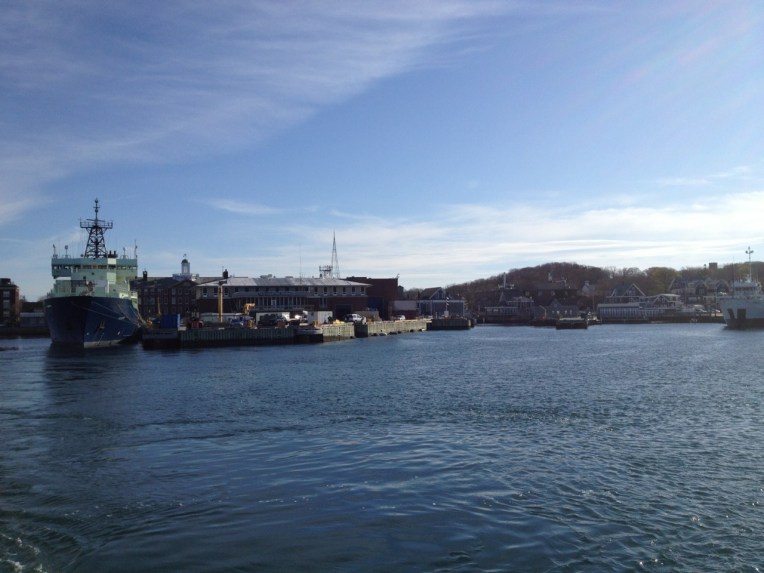
The ship’s Internet access is malfunctioning, so updates might be infrequent. Wish us luck.
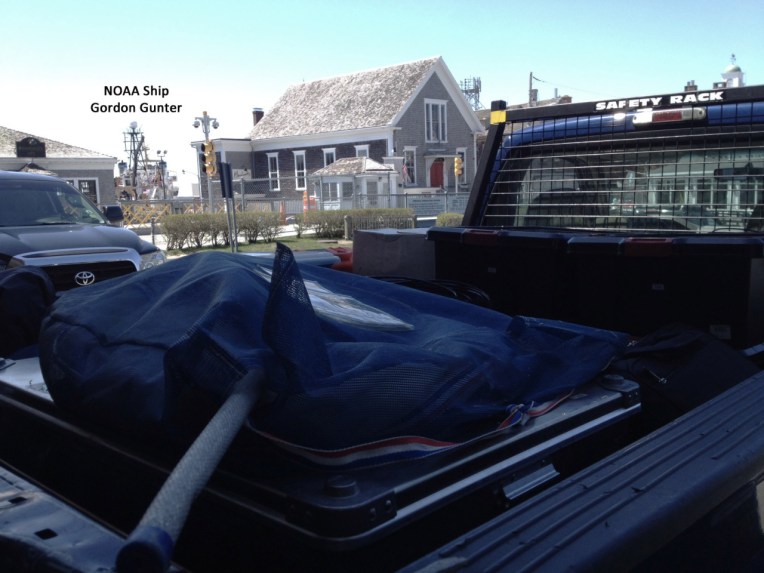
The Gunter arrived at the WHOI pier around 11:30 am and we started loading gear soon after (one truckload of gear is pictured above, from outside the WHOI Redfield Lab). After shipping gear to Barrow and Dutch Harbor, Alaska, driving it across the street seems very luxurious.

Great news!! Our spring right whale research cruise on the NOAA Gordon Gunter has been reinstated. Stay tuned for updates at sea from the Gulf of Maine.

Watching humpback whales in Maui (the black speck to the right of the palm tree).
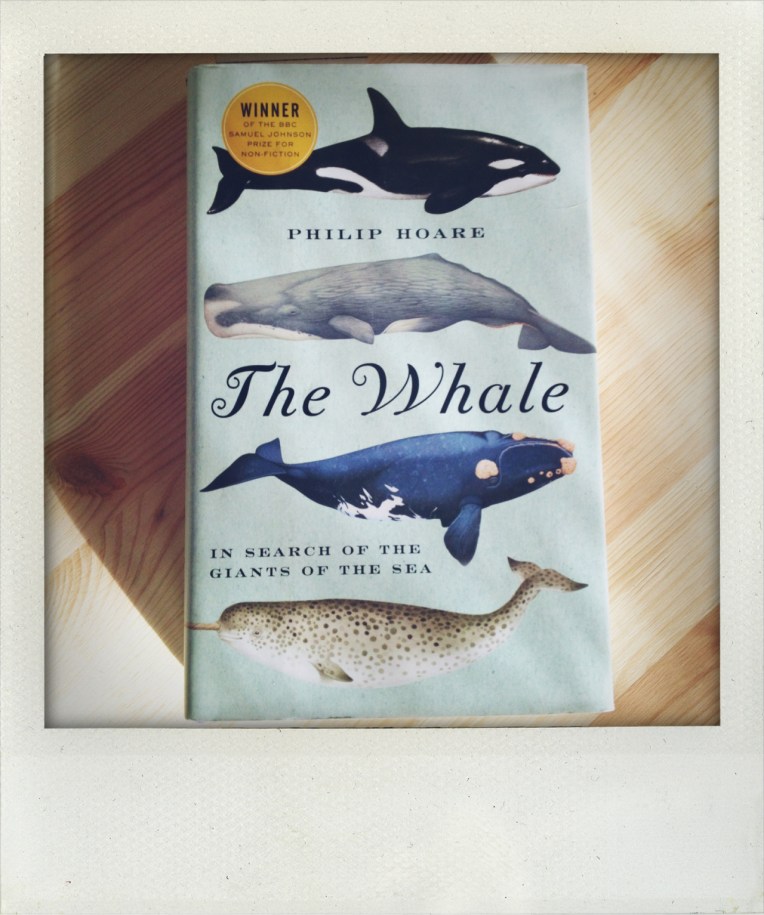
“The Arctic whales – bowheads, beluga, and narwhals – are the most tantalizing of all cetaceans. Rising and falling with the changing seasons of ice, they are barometers of an invisible world, spectrally floating within their bounded sea, locked into its cycle. They are philopatrous animals, loyal to the site of their birth, and the only whales to live in the Arctic throughout the year. One hundred thousand belugas swim in polar seas; the geographical remoteness of the less populous bowheads and their outriders, the narwhals, is such that they are seldom seen.”

Summary of ocean glider acoustic detections for right, sei, fin, and humpback whales in the Outer Fall during our cruise on the R/V Endeavor – December 2012.
“In such a silent flight, the sperm whale could not be outdistanced. More than any other marine mammal, it is a master of the sea. Using its muscle-bound tail, it can power its way thousands of feet below, its paddle-shaped flippers tucked into its flanks as neatly as an aeroplane’s undercarriage. And once below, it can stay down for up to two hours. To achieve this feat, a whale must spend much of its time breathing at the surface – its ‘spoutings out’. as the sailors called them – taking some sixty to seventy breaths in ten or eleven minutes.”
“…the Sperm Whale only breathes about one seventh or Sunday of his time” – The Fountain, Moby Dick
 Nadine Stewart J Lysiak